
Defining Mountain Lion Depredation in California
By Amy Rodrigues
I. Definition
Historically, the word "depredation" has
been used in the context of a military raid or pillaging a village. In the dictionary, it is defined as:
- the act of preying upon or
plundering; robbery; ravage
- A predatory attack; a raid.
- Damage or loss; ravage
Wildlife management agencies primarily use the word
depredation for instances where a wild predator attacks or preys upon a
domestic animal, such as a family pet or livestock.
In places where it is legal to retaliate for this "damage or loss" by
having the nuisance wild animal killed, a Depredation Permit is issued to
the pet/livestock owner.
Coincidentally, because the word is the combination of
the prefix "de" meaning removal or reversal, and the root "predation," for a
wild animal hunting prey, the term "de-predation" is also commonly used to
describe the depredation permit in terms of it being
the removal of a predator.
So, the initial predatory attack and the resulting permit for killing
the lion both use the word depredation, even though a slightly different
definition may be implied.
Either way, if a mountain lion damages a person's property in
California, a permit must be issued to have the lion
killed if one is requested.
II. History
Ranching
began in North America during the 16th century when early explorers and
settlers first brought over livestock from Europe.
Over four-hundred years later, the ranching industry has become a
cornerstone of American culture.
During WWI, increasing cattle production to support the troops was
seen as a patriotic duty. Wild
animals were either viewed as competition (deer, elk, bison, etc) for
grazing resources, or as a liability (wolves, cougars, prairie dogs,
beavers, etc) because of predation or causing damage to ranching land.
Thus, wildlife was a problem and viewed as something that needed to
be controlled and often removed altogether.
Many people believed then, and often still to this day,
that:
- the government should remove nuisance wildlife
- it is acceptable or even encouraged to kill wild animals on one's land
- wild animals belong out in the woods, away from people
- wildlife should "know better" than to come onto our land
Because ranching is so deeply embedded in our past, for
centuries, the ranching industry has been able to let livestock roam freely
(in many cases on public lands) and as a rule, create barriers to keep their
animals in -- not necessarily to keep wild ones out.
When wolves, coyotes, or lions prey on these over-populated and
defenseless livestock herds, ranchers can legally kill the predatory
wildlife themselves or make a phone call and have a tax-payer-funded
professional come out and kill the nearest wolves, coyotes, or lions.
Every state except for
Florida allows these depredation retaliation
kills on mountain lions even though the scientific community by and large
agrees it will not prevent future losses.
Mountain lions are territorial and when one is killed, a new lion
will move in to fill the space -- usually a younger and more curious cat --
and may continue the cycle of livestock losses and having lions killed.
Shooting a lion does not undo the death of a domestic animal, does
not prevent future depredation attacks, and costs tax payer money.
Yet, our society continues to allow people to kill wild animals for
what is commonly seen as only an emotional revenge and false hope it will
solve their problem.
Florida
is
currently the only state that will not issue depredation permits for
panthers that threaten or have killed domestic animals.
Residents are allowed to scare a panther away if it is on their
property or stalking a pet, but they may not injure or kill it.
This policy is due to the fact panthers are federally listed as a
critically endangered species and only an estimated one-hundred are left in
the wild. Every single panther
is essential for the recovery of the species.
Because residents do not have the luxury of a depredation permit, it
is common knowledge in Florida
that they must be responsible pet owners and take preventative measures.
No other state values their lions enough to enact similar policies
and require its citizens to be proactive.
Coexisting through non-lethal measures remains a choice and not an
obligation, even though it has proven to be a highly successful and
relatively cheap way to avoid conflicts with wildlife.
In the
West, there is no limit to the number of depredation permits a
person may be issued, no prerequisites for animal husbandry (such as not
tying a goat to a fencepost over night), and no required education or
assistance after the incident to help the owner prevent future losses.
III. Prevention
While killing a lion for depredation is
historically common and culturally acceptable, it is not a productive
solution and is an unnecessary loss of life.
MLF has created a variety of information and tips for keeping
domestic animals safe and coexisting with wildlife.
These resources for non-lethal animal husbandry techniques are
available and explained more thoroughly in the
Protecting
Pets & Livestock section of this website.
The Basics
Never Feed Wildlife
Feeding wildlife such as deer, opossums, or raccoons
attracts their predators to your home and creates a safety risk.
Make sure that food set out for pets, livestock, or birds is
accessible only to the animals that you are trying to feed.
Fence in vegetable and fruit gardens that might attract wildlife.
Landscape your yard with plants that deer do not like to eat.
The California Department of Fish and Game's
Gardener's Guide to Preventing Deer Damage
has tips on which plants to grow and which ones to remove.
Keep Your Pets Safe
Cats and dogs are easy prey.
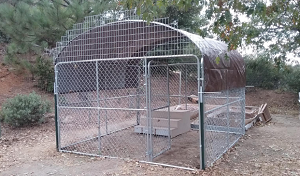
Keep your pets indoors or secure them in a covered run.
At a minimum, bring them indoors between dusk and dawn when lions
most actively hunt. 
Install Frightening Devices
Mountain lions depend on surprise to catch their prey.
Installing either motion or timer-activated outdoor lighting around
your home and animal enclosures may keep mountain lions away.
You may also try loud noises, sprinklers, flashing lights, or other
frightening devices, such as those used to keep birds out of fields (more
details).
Protect Vulnerable Animals
Keep injured, sick and birthing livestock in fully
enclosed structures or under your watchful eye.
Immediately remove and destroy afterbirth, carcasses, and other
animal byproducts from areas near livestock enclosures or homes as part of
responsible
Animal Husbandry
practices.
Build Livestock Enclosures
The best protection measure is to secure livestock in
fully enclosed barns, pens, or sheds.
Place all
livestock
enclosures, both covered and open, away from any trees or brush that
lions might climb or hide within.
Openings, such as windows, doors, or large gaps provide access for
highly curious lions.
If covering your pen is not an option then you must
build a
tall fence. Mountain lions
have been known to jump 15 feet vertically.
Use
Guard Animals
Guard dogs specifically bred to protect livestock from
predators have been used for thousands of years in
Europe. Studies
conducted in Colorado,
Montana, Utah
and Idaho
show that properly trained livestock guard dogs reduce predation by as much
as 93 percent.
Livestock guard dogs are not pets, and must be specially raised and
trained in order to be effective.
They may also pose a risk to people, and are best suited to large
herds in remote locations.
Other guard animals, such as llamas and donkeys, are
sometimes effective; although they are primarily used scare away coyotes and
dogs, and may not be the best choice for preventing mountain lion
depredation. Horned cattle are
also being used in some ranching operations as a deterrent to predators.
IV. Getting a Depredation Permit in California
A. Sighting or Public Safety (No Depredation Permit)
If
a mountain lion is seen on one's property, or evidence of a lion is found
such as scat, tracks, or a deer kill, a phone call to the California
Department of Fish & Game may result in an officer coming out to
investigate, or they may simply record your sighting over the phone.
Because there has been no damage or immediate danger, a depredation
permit is not issued. Seeing a
lion is not legal cause to kill it.
If the lion has not threatened any people, pets, or livestock,
usually it is left alone to move on naturally.
However, if an officer (CDFG or police department) responds and the
lion is present, the fate of the cat is generally decided by the responding
officer. If for whatever reason
he deems the lion is a threat to public safety -- which can be as simple as
"the lion is in an area near people or a school" -- the agencies have the
authority to shoot the animal on site, or tranquilize and euthanize it
later. CDFG's current policy
(not legal documentation, just merely the internal consensus of the
"higher-ups") is to never relocate any mountain lions.
Therefore, officers who want to respond non-lethally have sometimes
attempted to scare lions back into the wild with pepper-spray or rubber
bullets.
B. Caught in the Act
If a mountain lion is found in the act of attacking a
domestic animal or is seen as an immediate threat to human life, it may be
killed by a resident, without repercussion, as long as the California
Department of Fish & Game is immediately notified after the incident.
CDFG will confirm it was the only option to prevent loss of life to
people or property (pets or livestock being the property).
A verbal depredation permit can be issued over the phone and followed
up later with the necessary documentation.
It is highly recommended to
contact CDFG first, before any action is taken against the lion.
If the Department finds there was no immediate danger, a shooter can
be prosecuted for poaching since mountain lions are a specially protected
mammal in California.
The local police department and/or county sheriffs office can also
respond to mountain lion-public safety calls to a 911 operator.
Depredation Permits expire after ten days because lions roam such large
territories.
A lion seen in the area after that time may not be the same one that
caused the damage. Many biologists believe younger,
dispersing lions are more likely to cause
depredation, and these cats will often travel
hundreds of miles to find a home range. A juvenile
dispersing lion may only stay in one area for a few
days. Adult resident lions will usually keep the
younger ones out.
Killing a non-depredating adult lion is not a good idea, as this
opens his territory for several younger lions to
move in.
CDFG typically freezes and stores the carcasses of mountain lions killed for
depredation.
Sometimes, if there is uncertainty about the killed lion being the
same one responsible for the depredation, a necropsy
(animal version of an autopsy) is performed to
analyze stomach contents.
Occasionally CDFG also has events where if museum experts help with
necropsies, they can keep the lion pelts for
taxidermy displays.
However, because CDFG usually does not preserve the lions with the
intention of using them for displays, frostbite and
other deterioration damages occur which reduce the
quality of the hide.
See example (pictured right) of a display lion whose ears were
frostbitten during freezer storage.V. Depredation Records
If a state game agency keeps a record of depredation,
it will generally only keep track of the number of mountain lions that are
killed for the offense.
Residents who do not wish to have an offending lion killed do not have to
report pet/livestock depredation losses to the state game agency.
In addition to the number of lions killed under depredation permits, California's Department
of Fish & Game also keeps track of the number of depredation permits it
issues.
You be the judge:
In California,
the Department of Fish & Game is the agency responsible for issuing
depredation permits and keeping track of the number of lions killed.
However, because the United States Department of Agriculture (USDA)'s
Wildlife Services branch is the agency that hires the county trappers who
actually hunt and kill depredating mountain lions, they also document
incident reports and lions killed.
More specifically, the Animal and Plant Health Inspection Service
(APHIS), maintains detailed records of all wildlife damage reports and the
inventory of kills. On their
website, APHIS lists reports from 1996 through 2007 according to fiscal
year. Although CDFG goes by
calendar year, the differences in their records raise some questions about
their accuracy in monitoring the number of lions killed and potentially
their credibility as a wildlife management agency.
Notice: from 2003 through 2007, APHIS recorded 114
mountain lions killed in addition
to CDFG's report of 501 (that's nearly another 23%).
Specific information about each depredation permit is not available
to the public (to protect the landowner's privacy), so MLF is unable to
verify the actual number of permits or lions killed.
|
California Mountain Lion Depredation* |
|
Year |
Permits
Issued (CDFG's records) |
Lions
Killed (CDFG's records) |
Lions
Killed (USDA's records) |
|
1972 |
4 |
1 |
N/A |
|
1973 |
21 |
4 |
N/A |
|
1974 |
21 |
2 |
N/A |
|
1975 |
15 |
2 |
N/A |
|
1976 |
29 |
6 |
N/A |
|
1977 |
39 |
7 |
N/A |
|
1978 |
32 |
8 |
N/A |
|
1979 |
51 |
21 |
N/A |
|
1980 |
41 |
12 |
N/A |
|
1981 |
41 |
12 |
N/A |
|
1982 |
66 |
18 |
N/A |
|
1983 |
63 |
27 |
N/A |
|
1984 |
94 |
37 |
N/A |
|
1985 |
135 |
58 |
N/A |
|
1986 |
130 |
46 |
N/A |
|
1987 |
113 |
50 |
N/A |
|
1988 |
148 |
61 |
N/A |
|
1989 |
182 |
77 |
N/A |
|
1990 |
193 |
71 |
N/A |
|
1991 |
201 |
73 |
N/A |
|
1992 |
195 |
81 |
N/A |
|
1993 |
190 |
71 |
N/A |
|
1994 |
328 |
121 |
N/A |
|
1995 |
331 |
117 |
N/A |
|
1996 |
281 |
105 |
67 |
|
1997 |
253 |
90 |
71 |
|
1998 |
237 |
109 |
91 |
|
1999 |
233 |
114 |
102 |
|
2000 |
245 |
148 |
139 |
|
2001 |
187 |
105 |
121 |
|
2002 |
218 |
123 |
104 |
|
2003 |
206 |
107 |
110 |
|
2004 |
245 |
116 |
133 |
|
2005 |
222 |
103 |
120 |
|
2006 |
145 |
77 |
115 |
|
2007 |
192 |
98 |
137 |
|
Total |
5327 |
2278 |
1310 |
|
 |
 |
 |
*does not include lions
killed for public safety in the field by responding CDFG or other law
enforcement officials
|
Region Breakdown |
|
Region |
Counties Included |
Graph Click
to Enlarge |
|
Northern |
Del
Norte, Humboldt, Lassen, Mendocino, Modoc, Shasta, Siskiyou, Tehama
and Trinity |
 |
|
North Central |
Alpine,
Amador, Butte, Calaveras, Colusa, El Dorado, Glenn, Lake, Nevada,
Placer, Plumas, Sacramento, Sierra, Sutter and Yuba |
 |
|
Bay Delta |
Alameda,
Contra Costa, Marin, Napa, San Mateo, Santa Clara, Santa Cruz, San
Francisco, Solano, Sonoma, and Yolo |
 |
|
Central |
Fresno,
Kern, Kings, Madera, Mariposa, Merced, Monterey, San Benito, San
Joaquin, San Luis Obispo, Stanislaus, Tulare and Tuolumne |
 |
|
South Coast |
Los
Angeles, Orange, San Diego, Santa Barbara and Ventura |
 |
|
Inland Deserts |
Imperial, Inyo, Mono, Riverside and San Bernardino |
 |
|
|