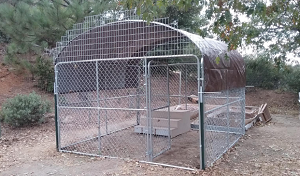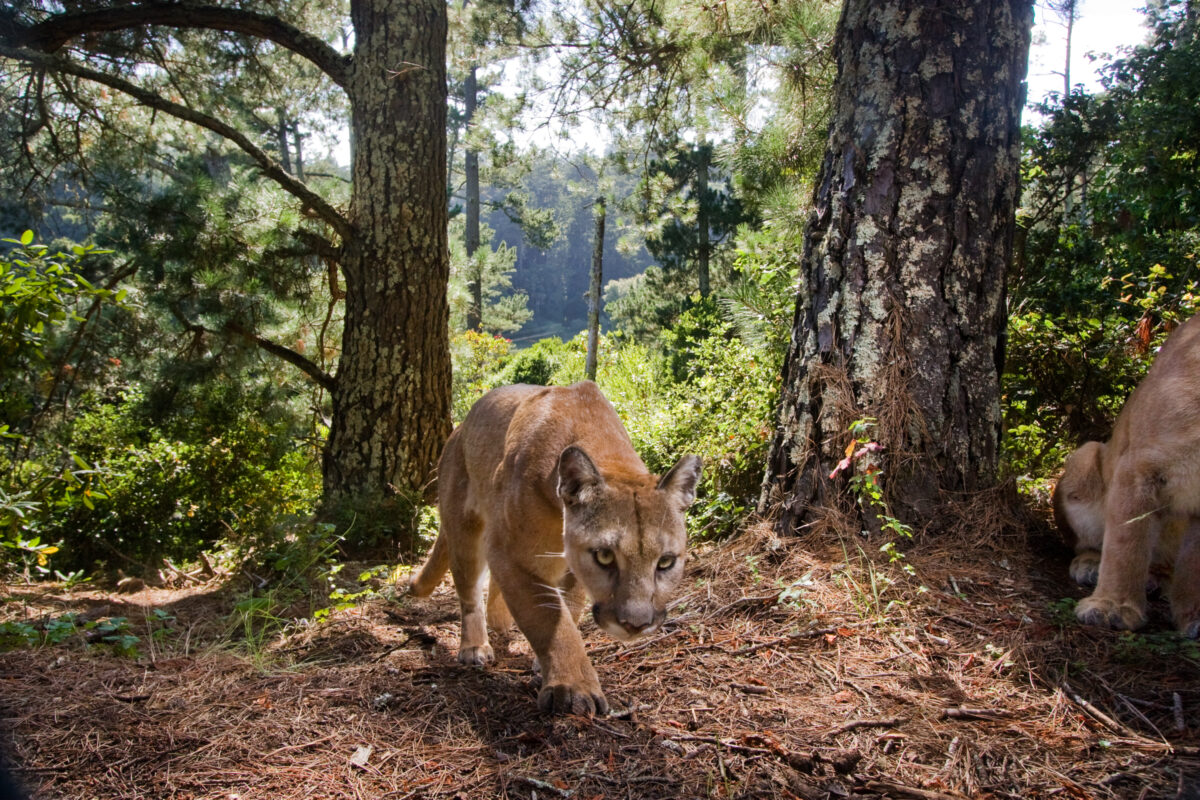



Protecting Pets
        and Livestock


  Activists Corner
   
 
  Mountain Lion
       Facts


  All Things Lion
   

  Safety Tips
   

    Share Your Story
   
 
Celebrating The
      American Lion

   
US History of
     Bounty and
     Sport Hunting
     of Cougars


Today's News: Fake Mountain Lion Warning Signs Posted
Earlier this week, warning signs about an aggressive mountain lion popped up in Montana's Two Moon Park. However, the signs were not put up by park staff nor had the local wardens received any reports of mountain lion sightings. In an interview with the Billings Gazette, Montana game warden Harold Guse mentioned that mountain lions are generally afraid of people... For this and other stories
Today's Cougar Comment: Twisting Science
Seven years ago, the South Dakota Department of Game, Fish & Parks (SDGF&P) presented the
world with their version of a mountain lion management plan. In that plan was the proposal for
an "experimental" mountain lion hunting season. They justifi ... For this and other blogs...
 

 ALL THINGS LION - Feature Story Archive

South Dakota's "2 + 2 = 5" Mountain Lion Population Estimate Error

Just one of the many holes in SDGF&P's 2010-2015 Mountain Lion Management Plan you could drive a bus through 

By Amy Rodrigues


The South Dakota Department of Game, Fish & Parks (SDGF&P) has submitted its 2010-2015 Mountain Lion Management Plan for public review. The new plan calls for reducing the state's mountain lion population by about 80 to 100 cats in order to bring their estimated population total down from an approximated 251 lions to only 150 to 170 mountain lions. The current 251 estimate includes kittens. Since mountain lion kittens may not legally be hunted, and South Dakota fails to recognize that killing a mother lion often results in her orphaned kittens starving to death, their mountain lion management plan ultimately calls for the removal of 80 to 100 adult lions. 


I'll be honest, I personally believe this plan to decimate the state's still-recovering mountain lion population is purely an early Christmas present for the agency's hunting pals, wrapped in a few fancy equations and colorful graphs so it looks like science. The plan appears sneaky, is a waste of taxpayer money, and exterminating a species in the pursuit of outdoor recreational fun is morally disgusting. However, I decided to give them the benefit of the doubt and objectively review their data first to see if at least their math was legit. (Spoiler Alert: It's not!) Changing personal opinions on how many mountain lions should be in the state is a long and heated debate - still very important - but fixing 2 + 2 = 5 is a much simpler and obvious correction. Emotion aside, let's just focus on the numbers for now.


The SDGF&P's entire mountain lion management plan is based on the department's calculation of the size of South Dakota's mountain lion population. One seemingly innocent "2 + 2 = 5" miscalculation and the whole house of cards comes tumbling down.  The problem is often that these "2 + 2 = 5" errors are complicated and buried within mathematical jargon . . . and of course state agencies rarely take the time to explain the process and source data in plain English. For the majority of people who don't speak statistics, it's common to just take the state's word for it and assume their lengthy calculations for population estimates are correct. Well, as a zoologist fluent in statistics, I'd like to show you their mistakes and the reasons why I (and math) believe their own data indicates a maximum of only 111 adult mountain lions living in South Dakota. If I was able to catch this error only a few minutes into my first read, what other slip-ups and poor judgments went into creating this management plan? SDGF&P is currently accepting public comments through July 26th on this plan. In addition to your own critique, I encourage you to point out the basic errors made in their calculations. 


Let's begin . . .


The Population Information section begins on page 4 of the South Dakota mountain lion management plan. The data says it's from 2007-2009 harvest numbers. At the end of that section it happens to mention, "No harvest occurred in 2008 due to movement of the harvest season to January 2009. Harvest data for 2009 provided a similar estimate of population size to that of 2007." The three years of harvest data used for the population estimate is actually just 2007's numbers, which means they are relying on only one year's data to assume population trends. SDGF&P justified this choice by saying 2009 was "similar" to 2007 and thus only needed to use results from one of the years. Their harvest data is noted below.


2007

2008

2009

Females

16

No harvest

15

Males

3

No harvest

11

Total

19

0

26


Yes, female data was similar (16 to 15) but male harvest (3 to 11) increased drastically!  That's up 267 percent . . . how convenient to ignore the higher harvest year.


If we overlook the fact that they are only using one year's data, and selecting their favorite year to build upon, they still screwed up their calculations.


They use harvest rate to guess population size, and "Harvest rate was estimated using number of radio-collared mountain lions harvested divided by total number of radio-collared mountain lions available to be harvested." Yes, this is a legitimate scientific way to estimate populations through harvest (hunting) data.  It assumes what happens to the radio-collared "community" is exactly proportional to what's happening to all lions in the state. It's certainly not 100 percent accurate, but it can give a ballpark estimate of the population size.


As a hypothetic example of this model: if I have 3 pet cats and 1 gets hit by a car, I would assume 1 out of every 3 pet cats (33 percent) in my region gets hit by a car. If there are 300 pet cats in my neighborhood, then this technique would conclude 100 (33 percent of the total) would be hit by cars.  This method gives a very rough estimate of what's going on with all the animals, but it's only one of the tools used by population biologists. The more animals studied, the more accurate the results.  If instead I had 20 pet cats, and still only that 1 was hit by a car, then now my data tells me only 1/20 (or 5 percent) of pet cats are hit by cars. That's a big drop from 33 percent in my first scenario. These numbers are also subject to wide interpretation because they do not indicate whether I live on a busy street, if the cats live indoors/outdoors, if older cats are more likely to wander into the street, distracted drivers, etc, and any other factors that may lead to cats being hit by cars. Multiple mortality factors should always be included when analyzing data of this sort.


But let's continue with South Dakota's math.


In 2007, SDGF&P had 35 radio-collared lions.  Out of the 19 mountain lions killed by hunters that year, 6 were SDGF&P's radio-collared research lions. Here's a breakdown - for reference - of the data from 2007 that will be used to calculate the mountain lion population:

Radio-Collared Females

20

Radio-Collared Males

15

Total Lions Radio-Collared

35


Radio-Collared Females Killed

5

Radio-Collared Males Killed

1

Total Radio-Collared Lions Killed

6


Total Females Killed

16

Total Males Killed

3

Total Lions Killed

19


Using the ratio to calculate total harvest, we see:


If 6 out of 35 radio-collared lions were killed (6/35 = 0.171 = 17 percent), that means 17 percent of the radio-collared population was harvested in 2007.  We now make the assumption (just like we did with the pet cat roadkill example) that 17 percent of all adult mountain lions were killed that year.  From the hunting data, we see that 19 mountain lions were killed. So those 19 lions are believed to represent 17 percent of the South Dakota population. That means according to this technique, there could be 111 adult mountain lions in the state (19 is 17 percent of 111).


Remember, in their proposed 2010-2015 Mountain Lion Management Plan, SDGF&P wants to kill about 90 of those. If accomplished, that would bring the adult lion population down to about 21 cats. For reference, Florida only has about 100 panthers left and because of this small population size, they are federally protected, considered critically endangered and in jeopardy of going extinct. Yet South Dakota could have about the same number of lions and is pushing to legally exterminate them . . . Again!


Back to the math...


In their management plan, South Dakota GF&P decided this 111 number was a little too small for their liking, and decided instead to focus on the female portion of the mountain lion population for their calculations.  The text on page 5 reads, "In 2007, estimates of population size were generated for the female segment of the population only due to total harvest of 1 radio-collared male." This makes sense. Only 1 radio-collared male was killed, and just as we saw with my hypothetic pet cat example, assuming trends based on the fate of one individual cat is not good science. 


So, SDGF&P calculated the female portion of the population - and this is where they really tripped up!


Correct Math:

5 out of 20 radio-collared female mountain lions were killed (5/20 = 0.25 = 25 percent). 16 total female lions were killed that year. If those 16 lions represent 25 percent of the female population, then we believe there are 64 female lions in the state (16 is 25 percent of 64).


Wrong Math:

And I quote from page 5 of the management plan, "Harvest rate for the female segment of the population was estimated at 0.143 (5/35 = 0.143) where 5 radio-collared female mountain lions were harvested of a total of 35 available radio-collared mountain lions. Total number of females in the population was then estimated by dividing total number of females harvested (n = 16) by harvest rate (0.143), which gave an estimate of 112 female mountain lions."


Do you see the problem? Whether it was a convenient typo, incapable employee, or honest mistake, SDGF&P used the wrong number. They divided by 35 (the total number of female and male radio-collared lions) rather than the actual 20 female collared lions. Diving by 35 (male + female) is okay, but it means the final 112 number also represents male + female.


The ratio stays the same: 5 collared females out of 35 total (male + female) collared lions = 16 females out of 112 total (male + female) lions. Or, 5 out of 20 collared females = 16 out of 64 total females. Either way, their numbers only let them assume 112 total lions or 64 females . . . not 112 females.


Had they looked at the whole population or done the female calculation correctly, they would have concluded there are approximately 111 or 112 adult mountain lions in the state (and that's still assuming hunting is the only cause of death and kittens are independent from birth).  If they want 150 adults, they are going to have to INCREASE the population to get there!!!


Another interesting point is that SDGF&P assumes 70 percent of the population is female (see why this is probably an error, too!). If there are 64 female lions, representing 70 percent of the population, this means there may only be 91 adult mountain lions in the whole state (64 females, 27 males). I may actually be cutting them some slack and overestimating by saying there could be 112 adult lions in South Dakota - but hey, I'm only using their data!


The South Dakota mountain lion management plan also uses other sketchy assumptions like the number of kittens and survival rates, and even territory size shrinking despite less food, that I encourage you to challenge. All the studies show that food abundance dictates territory size--the less food, the larger the territory. Feel free to include your personal opinions about the management plan and please see MLF's official comments to the plan once they are written and posted on the South Dakota State Page, but if nothing else, send them the following corrections to their Population Information section . . . because if they haven't learned 2 + 2 = 4 yet, they shouldn't be trusted to manage our wildlife.


While I may not agree with all of their assumptions, the following edits simply fix the mathematical errors and give the real version of the management plan their biologists intended to produce.  With my edits in bold, page 5 of South Dakota's Management Plan should read:


"During 2007-2009 when sufficient radio-collared female mountain lions were available to estimate the population post harvest, an estimate of harvest rate was generated for the female segment of the population. Harvest rate was estimated using number of radio-collared mountain lions harvested divided by total number of radio-collared mountain lions available to be harvested (Skalski et al. 2005). Estimates from 2007-2009 were compared to those generated via population reconstruction to adjust temporal change in the mountain lion population. In 2007, estimates of population size were generated for the female segment of the population only due to total harvest of 1 radio-collared male. Harvest rate for the female segment of the population was estimated at 0.143 0.25 (5/35 20 = 0.143 0.25) where 5 radio-collared female mountain lions were harvested of a total of 35 20 available female radio-collared mountain lions. Total number of females in the population was then estimated by dividing total number of females harvested (n = 16) by harvest rate (0.143 0.25), which gave an estimate of 112 64 female mountain lions. The following assumptions were used to estimate reproduction: 1) 50 percent of females were with kittens; 2) survival of kittens was 0.67; and 3) litter size was 3 kittens/litter (based on field data collected over the past 5 years [Thompson 2009, B. Jansen, unpubl. data]). Thus, the number of kittens added to the population was 112 64 females multiplied by 0.5) which equals 56 32 females with kittens. The 56 32 females with kittens were multiplied by 3 kittens/female for a total of 168 96 kittens born. This number was multiplied by the survival rate of 0.67 to estimate total number of kittens added to the population or 113 64 kittens. The sex ratio of the population was estimated at 70% females, based on observed data and those from other populations (Logan and Sweanor 2000), which provided an estimate of adult and transient males of 48 27. Thus, total number of males and females was 160 91 and this estimate was adjusted by multiplying by survival rate for males and females of 0.86 (Thompson 2009), which gave 138 78 adult mountain lions. Thus, total population was estimated at 138 78 adults and 113 64 kittens or 251 142 mountain lions."


If South Dakota's plan to kill 80 to 100 adult mountain lions is approved, they could exterminate the entire mountain lion population! They did it once before. Through this mountain lion management plan, all 78 adult lions could be killed (if there really are even than many to begin with) and the 64 predicted kittens listed above would all be less than one year old and unable to survive without their mothers - despite what SDGF&P thinks.


My only thought now is dear god I hope the numbers are wrong and there actually are more lions out there . . . somewhere.


Four ways you can help:
Donate Join MLF Volunteer Cougar Clippings

Join us on:  Mountain Lion Foundation
PO Box 1896 Sacramento, CA 95812
916-442-2666      800-319-7621
www.mountainlion.org

Copyright 1988-2010  - Material produced by the Mountain Lion Foundation is protected under copyright laws.
Permission to rebroadcast or duplicate is granted for non-commercial use when the Mountain Lion Foundation is credited.

Masthead Design Courtesy of MLF Volunteer Jenny Swartzbaugh


Mountain Lion Foundation


Join us on:


About Social Networking
 

Donate Now
 Your membership, at any level, makes you part of a nationwide  network of individuals who  commit dollars and energy to  the cause of Saving America's Lion.