
Answers to your questions about mountain lions.
Mountain lions have a distinctive heel pad with 3 lobes visible at the rear of the track (dogs typically only register 2 lobes). Their claw marks usually do not show in the track with some exceptions. When walking, a cougar’s rear paw often steps in the track of the front paw, creating an overlapped pattern. This is called direct register. Cougars will also walk with the rear track registering in front of the front track. This is called an overstep walk. Both of these gaits can occur at greater speed indicating a trot, which will increase the stride length. Their paws have a leading toe, similar to how a human hand has a leading finger. This indicates right or left paw. Dog tracks are more symmetrical with no leading toe and the negative space between their toes and heel pad creates an ‘X’ shape.
Click here for more information on mountain lion tracks, scat and other signs.
YES! The American lion’s scientific name is Puma concolor, and is sometimes referred to as “the cat of many names.” The scientific name was changed from “Felis concolor” in recent decades. Mountain lions once ranged more extensively than any other mammal in the Western Hemisphere. Historically they could be found anywhere from the Canadian Yukon to the Straits of Magellan — over 110 degrees in latitude — and from the Atlantic seaboard to the Pacific Ocean. As a result, each native tribe and group of European explorers gave the cat a different name. Today, mountain lions are listed in dictionaries under more names than any other animal in the world. Writer Claude T. Barnes listed 18 native South American, 25 native North American, and 40 English names for the same animal. Depending on the region and native language, common names for the American lion include: mountain lion, cougar, panther, puma, painter, el leon, and catamount.
Although the mountain lion may have more names and nicknames than any other animal, the following are not names for lions and represent completely different species: bobcat, lynx, ocelot, jaguar, leopard, cheetah, Asiatic lion, African lion, and tiger. Many people have heard the term “black panther,” but these are actually melanistic jaguars or leopards: a genetic trait that makes an individual cat’s fur appear much darker than the usual coloration. To date there has never been a confirmed case of a melanistic (black) mountain lion.
Puma concolor means lion of one color. Adult mountain lions have a tan-colored coat — much like the African lion — but are slighter in build with a head that is smaller in proportion to its body.
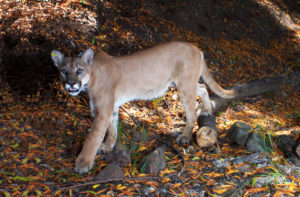
The sexes look alike, though male lions are 30 to 40 percent larger than females. Though sizes vary greatly throughout the cat’s geographic range, a typical adult male will weigh 110 to 180 pounds and the female 80 to 130 pounds. Exceptional individuals have exceeded 200 pounds, but this is rare. Adult males will measure 6 to 8 feet from nose to tail tip and females 5 to 7 feet. The most recognizable feature of the American lion is its long and heavy tail, which measures almost one-third of the lion’s total length.
Mountain lion kittens or cubs (either term is correct) have camouflaging spots and rings around their tails that fade as they mature. These spots fade to faint dapples by about 9 months of age and at around a year old, young cougars look nearly identical to an adult. This can create confusion because it may look like multiple individuals are traveling in together. If you see more than one cougar together this is usually a family group. This family will break up when the young are, on average, 15 months old.
To learn how to identify a lion’s age and gender, check out this helpful ID Guide from the Washington Department of Fish and Wildlife.
To deer, yes! To people, not so much. Human encounters with mountain lions are rare and the risk of an attack is infinitely small. You are more likely to drown in your bathtub, be killed by a pet dog, or hit by lightning. If lions had any natural urge to hunt people, there would be attacks every single day. Instead, they avoid us.
But if you live, work, or play in cat country, be alert! Avoid walking alone between dusk and dawn when lions are most active. Keep your children and pets close to you. Never approach or corner a mountain lion (or any wild animal). If you do encounter a mountain lion, STOP. DO NOT RUN. Unlike safety advice for encountering bears, do not act timid or play dead in front of a cat.
Instead: Maintain eye contact. Stand tall. Look bigger by opening your coat or raising your arms. Slowly wave your arms and speak firmly. Back away slowly but be careful not to trip or fall over. Most encounters where a cougar approaches a human are because the cougar wants to move the person away from kittens or a food resource. Backing away slowly will provide space, and the cougar will move on once there is enough space. Some very rare encounters are aggressive. Throw items at the lion if necessary. Give the cat room and time to move on. Remain aware and cautious. Bear spray is effective on cougars. It may take more than one spray, so don’t empty the can on the first deployment. Be sure to educate yourself on the correct way to use bear spray.
In the rare event of an attack, fight back. Most people succeed in driving the mountain lion away.
The Mountain Lion Foundation is the nation’s leading nonprofit dedicated exclusively to the conservation of mountain lions. Through science, education, advocacy, and practical coexistence solutions, we work to protect mountain lions and the healthy, connected landscapes they help shape.
If you still cannot find what you are looking for please contact us and we will try to assist you in finding what you are looking for on the MLF website. Our email is info@mountainlion.org, and our phone number is 916-442-2666.