What you don’t know about livestock guardian dogs

Livestock Guardian Dogs are a new addition to ranching culture in the United States. Only since the 1970s have dogs been implemented at scale on homesteads and ranches to protect livestock.  However, these canines’ place as a cultural staple of coexistence around the world stretches back thousands of years.

Humans’ relationship with livestock guardian dogs is special, and represents one of the most effective coexistence strategies across the globe. From Patagonia to Botswana, farmers and ranchers benefit from working with these ancient pastoral partners.

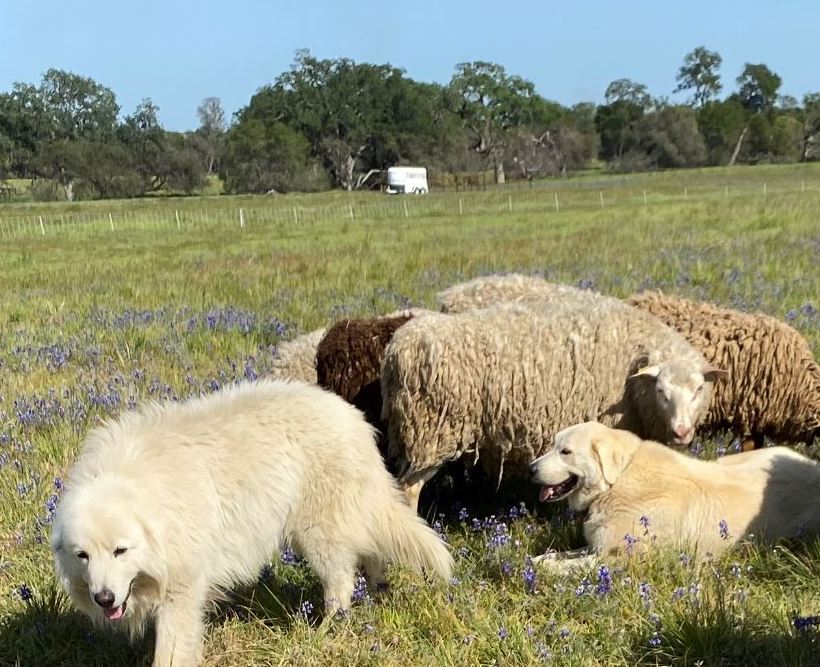
Chego and Azra with flock
Chego and Azra protect their flock from carnivores. Photo courtesy of Gowan Batist.

Just like most people will never see a wild mountain lion in person, most people won’t work with these unique dogs either. But it’s increasingly important that all of us understand more about them. As planned grazing operations move closer to urban areas, such as goats clearing brush in fire prone freeway margins in California, more of us will experience the moment of cognitive dissonance that comes when a member of the flock suddenly starts to bark!

A few things you (probably) didn’t know about Livestock Guardian Dogs:

  • Livestock Guardian Dog breeds are considered “primitive” and come with unique skills and challenges in the modern world.
  • Great Pyrenees dogs have an extra set of toes, called dewclaws.
  • A Livestock Guardian Dog may consider their territory to be multiple square miles, making containing them sometimes a difficult proposition.
  • It may take three years or more before a Guardian Dog can work effectively in the field unsupervised.
  • Livestock Guardian Dogs are a family of breeds, NOT a description of a role any dog can do. Other dog breeds, or mixes cannot reliably be expected to perform as a Livestock Guardian.
  • Livestock Guardian Dogs bark — a lot. Territorial barking alerts wildlife to keep their distance, keeping livestock and mountain lions both safe. Laws throughout the US protect the right of these dogs to work in some places, but in others they are subject to barking dog laws.
  • There are many harmful myths in the US about Livestock Guardian Dogs, including some advocating for raising them without human contact. These dogs have always been treated as part of traditional pastoralist families.

If you want to learn more livestock guardian dogs, join Mountain Lion Foundation’s Coexistence Program Manager, Gowan Batist, for our next Living with Lions Webinar on Wednesday, March 20 at 12pm PT.

Register for Livestock Guardian Dogs: An Ancient Solution to Modern Wildlife Conflicts here.

Resources and Cited Studies about Livestock Guardian Dogs

Louise Liebenberg: https://predator-friendly-ranching.blogspot.com/

Texas A&M: https://sanangelo.tamu.edu/research/lgd/

Cougar Conservation Botswana https://www.cheetahconservationbotswana.org/information-for-farmers.html

Cheetah Conservation Botswana LGD Handbook: https://www.cheetahconservationbotswana.org/uploads/6/4/3/3/64330039/ccb_lgsd_handbook_2016.pdf

Aggregated studies by Texas A&M: https://sanangelo.tamu.edu/research/lgd/lgd-literature-archives/

Cougar predation of feral donkeys: https://besjournals.onlinelibrary.wiley.com/doi/10.1111/1365-2656.13766

University of California Cooperative Extension Guidebook: https://ucanr.edu/sites/Rangelands/files/305121.pdf

University of Tasmania Study: https://www.utas.edu.au/about/news-and-stories/articles/2023/the-ancient-practice-of-livestock-guardian-dogs-is-highly-successful-on-australian-farms-today

South Dakota State University Extension: https://extension.sdstate.edu/livestock-guardian-dogs-improved-protection

University of Utah Thesis; Evaluating the Effectiveness of Livestock Guardian Dogs: https://digitalcommons.usu.edu/cgi/viewcontent.cgi?article=8744&context=etd

Phys.org “Landscape of Fear”: https://phys.org/news/2024-03-livestock-guardian-dogs-landscape-predators.html

How many mountain lions are in California?

You’ve probably seen some recent media coverage about the “lower than previously thought” number of mountain lions in California. These preliminary estimates, released by the California Mountain Lion Project, are just that — preliminary. Here at the Mountain Lion Foundation, part of our work is to be a clearinghouse for the most accurate and up to date scientific information on mountain lions. With that in mind, we reached out to some of the scientists at the California Mountain Lion Project, now known as California Carnivores, to ask, “What’s the story with these new, lower estimates of the number of lions in California?” 

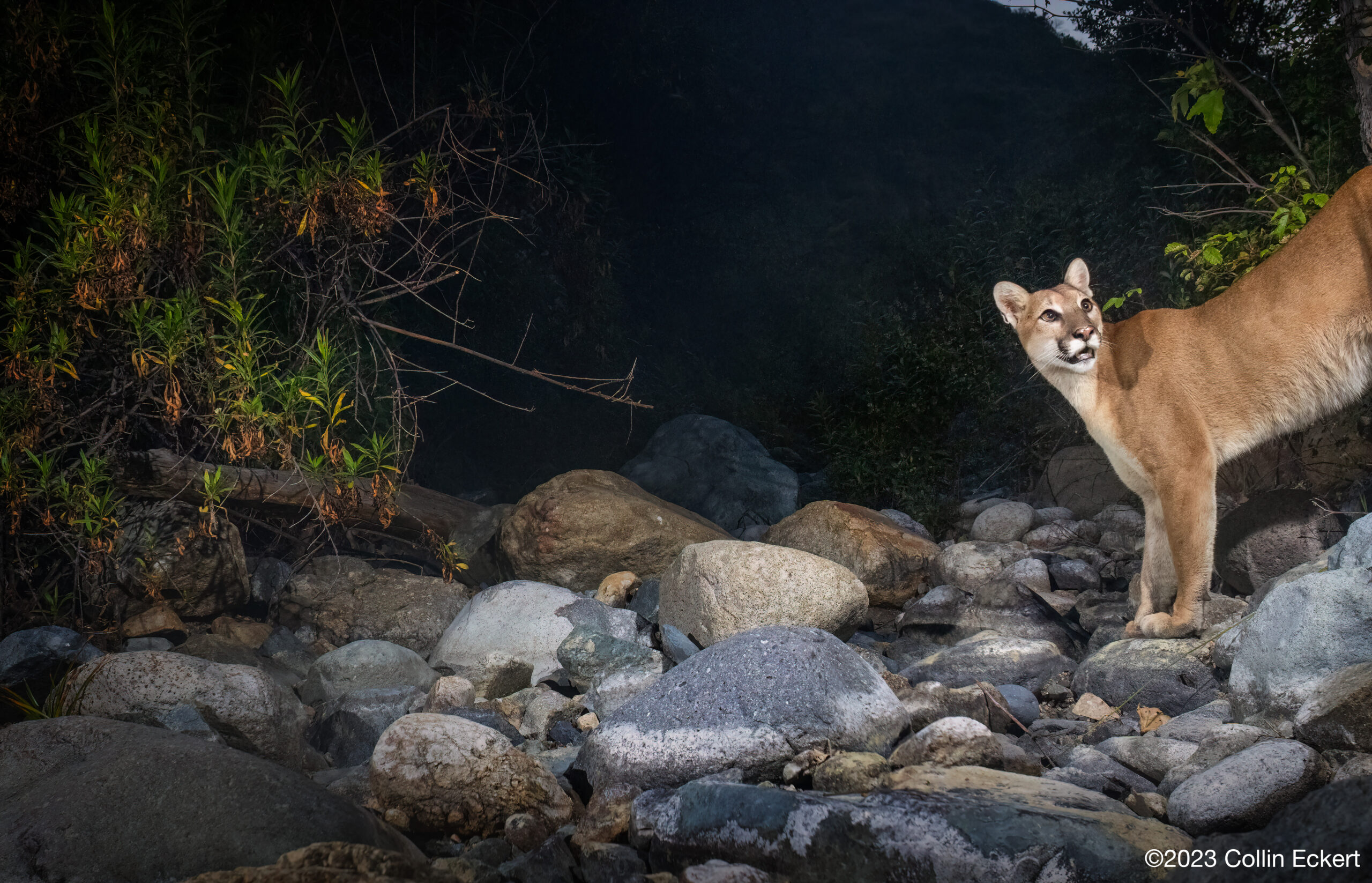
Cougar in the Santa Ana Mountains in southern California
A cougar in the Santa Ana Mountains in southern California. Image courtesy of Collin Eckert.
What is the California Mountain Lion Project?  

The California Mountain Lion Project formed in 2001 under the Karen C. Drayer Wildlife Health Center at the University of California at Davis. Originally, the project centered on the Southern California mountain lion population, a major conservation concern. The project’s research  focused on habitat fragmentation, disease, prey interactions with mountain lions, and coexistence with humans in Southern California. The program has expanded over the years, and its name changed to California Carnivores to reflect that.  

How many mountain lions are there in California?  

Justin Dellinger and the rest of the research team’s work has resulted in two preliminary population estimates for mountain lions of all age classes (adult mountain lions, juveniles, and kittens) in California. Both estimates represent the median value of two population estimate ranges utilizing slightly different data, including telemetry data from GPS collars and genetic sampling. Using only genetic sampling data yielded an estimate of 3,200 mountain lions of all age classes. The method that factored in telemetry data as well yielded an estimate of 4,500 mountain lions of all age classes. 

The estimate of 4,500 mountain lions of all age classes is likely to be the more accurate estimate, as it considered home range sizes of collared animals. Despite the widespread media coverage, these estimates should be considered preliminary until they go through rigorous review by scientific peers.  Also, they cannot be widely used for management until the findings are peer reviewed.  

A mountain lion in California.
A mountain lion in California. Image courtesy of Roy Toft.
The old estimate for mountain lions was 6,000. Why is this new number so different?  

The number of 6,000 mountain lions in California was a “back of the napkin” estimate. It took a reasonable mountain lion density and multiplied it by about how much habitat was in the state. This type of calculation has value, especially when there is no robust population assessment. However, the 6,000 mountain lions estimate was always  a weak one.  

The preliminary finding of 4,500 mountain lions was derived from robust data. If it is accepted in peer review, it will likely be the most accurate, current assessment of the mountain lion population in California.  

Ultimately these numbers cannot be compared well, as they came from two different points in time with entirely different methodology. If the population estimate is accepted in peer review, the Mountain Lion Foundation will accept it as the updated number of mountain lions.  

What does this estimate tell us?  

Of course, the preliminary result tells us there are 4,500 mountain lions of all age classes. Even though that number is lower than previously thought, it’s still good news. On a statewide demographic level, mountain lions are doing well in California overall. However, the number of mountain lions in an area is not the only indication of how well mountain lions are doing.  

Genetic health is a major indicator of population health, and often functions as a “canary in the coal mine” for population decline. It is widely understood that habitat fragmentation and lack of connectivity have caused genetic declines in Southern California mountain lion populations, threatening their long-term viability. This threat  prompted the development of the Wallis Annenberg Wildlife Crossing near Los Angeles, along with a number of other important wildlife crossings across the state, and the petition by the Mountain Lion Foundation and the Center for Biological Diversity to list these lions populations as endangered in California. (That petition is currently still under review.)  

However, we can look at this population estimate as a sign of hope. While mountain lions in California are struggling with habitat fragmentation and loss of genetic diversity in some regions, the issues haven’t caused the populations to become too small yet. Having a large enough population size means that populations will be better able to respond to interventions to promote genetic diversity, such as wildlife crossings.  

A mountain lion at night in California.
A California mountain lion at night. Image courtesy of Roy Dunn.
Mountain lion densities are higher or lower based on the landscape  

Mountain lion density tells us approximately how many mountain lions there are in an area. Typically this is listed in research as “mountain lions per 100 km².” Lion density itself is continuous over the landscape, meaning there won’t be a big jump in lion density in adjacent areas.  

The primary factor that limits how many mountain lions can be in an area, is the availability of prey. Meanwhile, the prey are limited by their access to vegetation for foraging. So, the greatest factor that influences mountain lion densities is typically the vegetation in the area. If there is abundant water and forage for prey species, there will likely be higher mountain lion densities.  

This relationship leads to higher mountain lion densities in regions that have abundant water and forage, like the western Sierra Nevada and the western Coastal Range.  

There are mountain lions in the Central Valley and the Mojave 

There has been some media coverage stating that the Central Valley and Mojave have no mountain lions at all. To clarify, those two regions were not sampled directly so their estimated mountain lion populations were estimated based on other data from the study and the habitat in the area. 

Researcher Justin Dellinger has published works on these populations that can be found here.

Is the mountain lion population increasing or decreasing?  

This preliminary estimate of 4,500 mountain lions of all age classes represents a point in time. Monitoring with similar methods will need to be repeated in the future to assess population trends for mountain lions in California.  

From a number’s perspective alone, mountain lions are doing well. While lion populations in certain areas are lower and more fragile than others, from a statewide perspective, their numbers are not too low. Additionally, mountain lions in California are not overpopulated. Overpopulation was a major fear and fueled opposition to the work of mountain lion advocates on Proposition 117,  which permanently banned mountain lion sport hunting in 1990 in California. Prior to the legislation mountain lion hunting had been on moratorium since 1972. (These efforts during the 1980s eventually gave birth to the Mountain Lion Foundation as a nonprofit organization, in 1986.) Research overwhelmingly shows that mountain lions do not need to be hunted to avoid overpopulation, as their social structures and food availability do that on their own. This research provides another reference point, too: More than 50 years after a ban on hunting, mountain lions have not become overpopulated. 

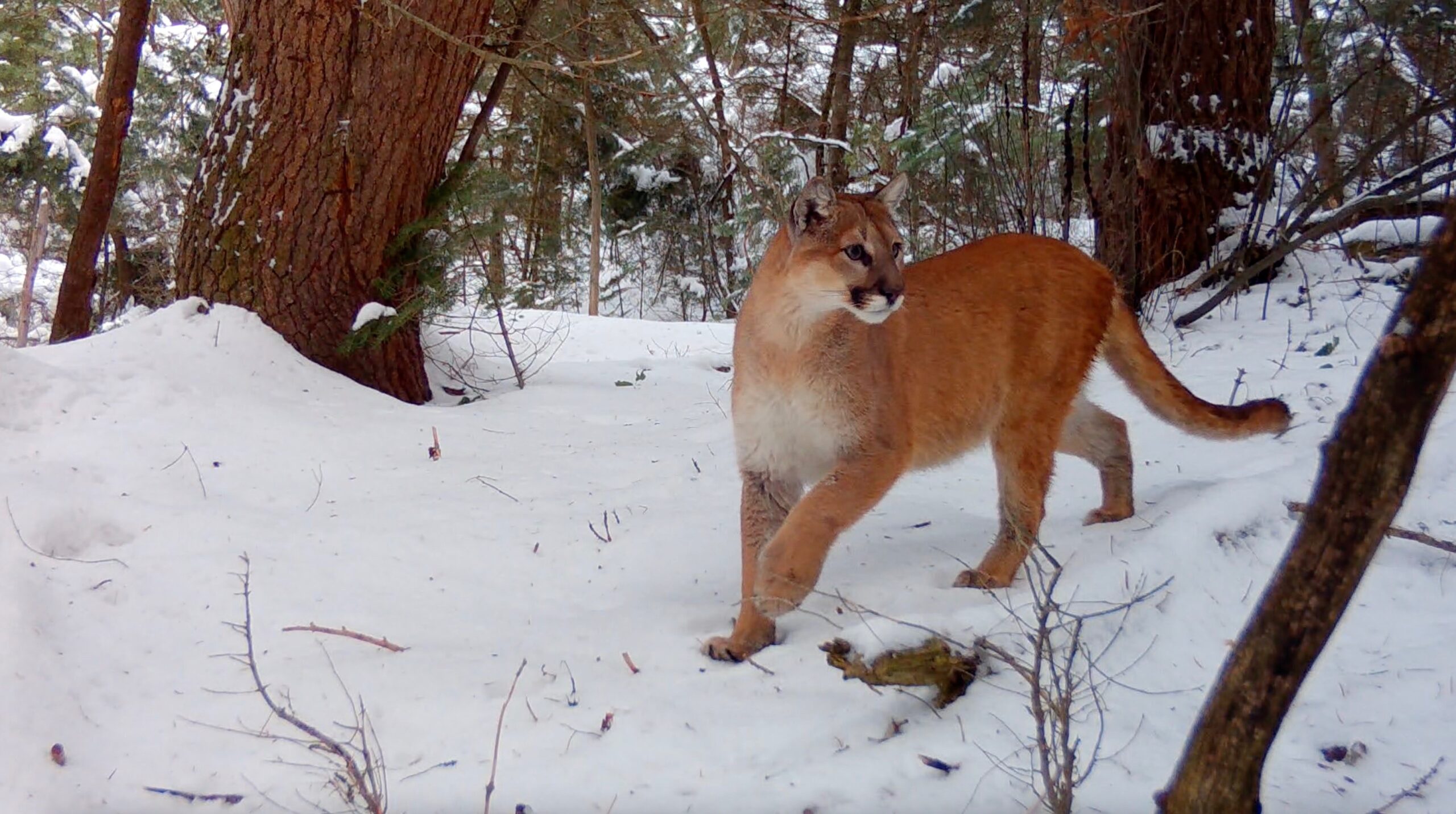
A lion walks away from a trail camera in northern California.
A lion walks away from a trail camera in northern California. Image courtesy of Dan Potter.
How does this estimate compare to other states and their methods? 

Most states with mountain lions attempt to estimate their population in some way. Not all of these methods are created equal, however. Some rely heavily on hunter harvest statistics, which introduce considerable bias, and on little to no supplemental field data. Other methods are quite thorough, and data from the field are gathered regularly. The work done by the California Mountain Lion Project stands apart from many of these monitoring efforts mainly by its scope. Studies often intensively study one or two areas and apply those results to the remainder of the state. The new California estimates, by contrast, are sampled from many regions across California. This wide sampling effort will help to achieve a more accurate picture of the mountain lion population.  

Some states have no official estimates at all. Currently, the only states with breeding populations and no official population estimates are Wyoming, Idaho, and Texas. As a result, scientists and managers are largely left to rely on these “back of the napkin” population estimates much like California’s old “6,000 mountain lions in the state” number. By looking at the discrepancy between California’s back of the napkin calculation, and the preliminary study estimate, we see the potential of overestimating populations when real data are not available. This discrepancy has particularly  negative effects when hunting quotas are based on those flawed methods and assumptions.  

Here at the Mountain Lion Foundation, we look forward to seeing this work once it is ready for publication, and we will continue to use the best available evidence in our work to advocate for mountain lions in California and across the country.  

Cats aren’t trophies in Colorado (or anywhere else)

By Samantha Miller, Campaign Manager, Cats Aren’t Trophies

Greetings from the frontlines of the CATs campaign in Colorado! I am thrilled to provide an update on Initiative 91, the ballot initiative to ban trophy hunting and trapping of Colorado’s mountain lions, bobcats, and lynx. I would also like to introduce myself as the CATs campaign manager to the Mountain Lion Foundation membership.

Prior to joining CATs, I advocated alongside Mountain Lion Foundation in my role as the executive director of Washington Wildlife First. During that time, we achieved significant victories for wildlife in Washington state, such as the prohibition of spring bear hunting and the advancement of a legislative proviso for agency reform at the Washington Department of Fish and Wildlife.

I know the excellent work in Washington is still underway, and I was honored to be asked to return home to Colorado to lead this once-in-a-generation ballot initiative for the Center for Humane Economy and Animal Wellness Action.

I have been a lifelong carnivore advocate and worked across the eleven Western states on carnivore coexistence policies. Right now, Colorado has the unique opportunity to lead the nation in biodiversity restoration and wildlife coexistence policies. Initiative 91 is central to this opportunity.

Indiscriminate sport hunting of mountain lions and bobcats damages ecosystems and increases conflicts with people and livestock. Colorado is ground zero for chronic wasting disease and research has shown that mountain lions self-select to prey on deer and elk carrying the disease before they show symptoms, while not catching or transmitting the disease. Cats keep herds healthy!

Image courtesy of Melissa Groo

As CATs charges into February with Initiative 91, we mark a crucial campaign milestone: We are now on the clock to gather 124,238 verifiable signatures from registered Colorado voters by July 4th. We must meet this minimum to qualify for the November 2024 state ballot. This means we need not just to meet the state minimum but to surpass it and collect 170,000 signatures, accounting for potential signature invalidations.

CATs is printing petitions, conducting training sessions, and hitting the ground to collect signatures the first week of February. But we cannot qualify for the 2024 state ballot without your help. Please register as a volunteer signature gatherer, called a “circulator,” to receive a petition packet, training notices, event updates, and recorded sessions. Any United States citizen aged 18 and over can collect signatures in Colorado, even if you’re not a Colorado resident.

Together, we have the power to protect mountain lions, bobcats, and lynx from the brutality of trophy hunting and trapping, and champion healthy, thriving ecosystems in Colorado!

Volunteer to gather signatures for Colorado’s cats!

A special thank you to The Mountain Lion supporters!

A mountain lion in the snow
Photo by Denise Peterson

As we embark on the 2024, we would like to kick off the year with off with a very special thank you to our members. We are so grateful to you for sharing a deep appreciation for mountain lions by supporting our continued efforts on behalf of these magnificent creatures — so that they may not only survive, but flourish in the wild.

As you know, we design our programs to raise awareness about the importance of mountain lions and their habitats, advocate for policies that protect them, and support coexistence with these remarkable creatures. Through education, outreach and activism, we wpork to create a future where mountain lions and their habitats are protected and thriving.

The Mountain Lion Foundation succeeds because people like you cherish our beautiful big cats and recognize the importance of standing up to preserve our natural world and protect the creatures that call it home. Thank you for your continued support. We look forward to event more success in 2024.


A Victory for Washington’s Cougars

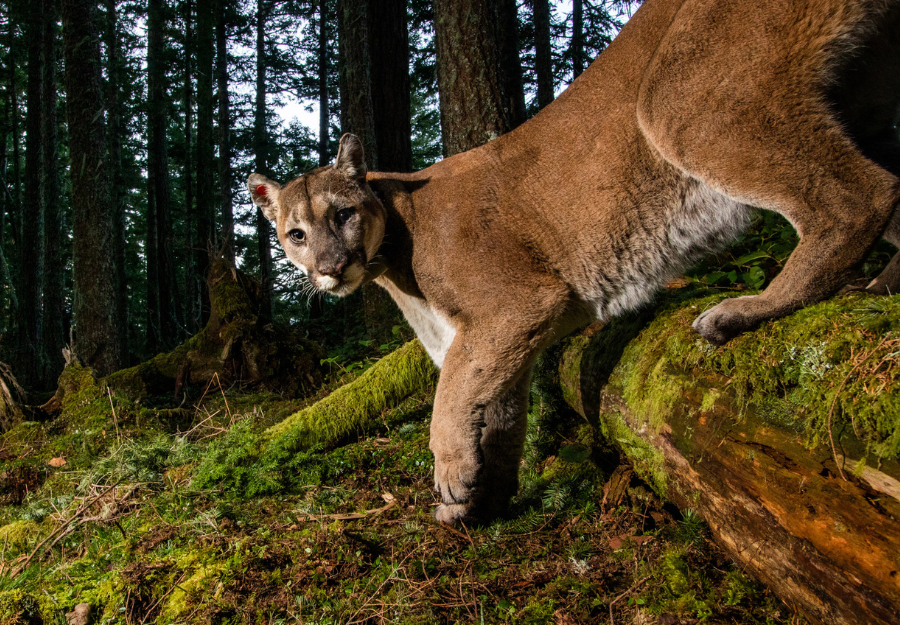
Cougar on a mossy log
By Sebastian Kennerknecht

Times are changing in Washington. Our Fish and Wildlife Commission protected cougars.

Late on December 15, 2023, the Washington Fish and Wildlife Commission voted overwhelmingly to support new rules that will protect Washington’s cougars and bears from overhunting.

The commission voted 7-2 in support of a petition filed by the Mountain Lion Foundation and our partners. The vote directs wildlife agency staff to revise rules in ways that should prevent overhunting and bring science and common sense back to cougar hunting laws. You can watch the debate and the vote through TVW.

This vote is a historic step in support of cougars, and commissioners deserve our support and thanks for a difficult and brave action on behalf of carnivores.

Commissioners asked hard questions about the petition and the science behind it, and in months to come, we expect them to push the department to develop strong new rules that protect cougars based on the concerns raised in our petition, and the department’s own science that we cited in the petition (science which a remarkable letter by 50 independent scientists endorsed).

Our petition asks for commonsense, science-based hunting rules that:

  • root hunting limits in the extensive field work conducted by Department of Fish and Wildlife biologists
  • cap all human-caused mortality (to avoid excessive killing by sheriffs undoing the science-based limits, for instance)
  • limit hunting to 12-16% of an area’s population (a limit based on careful scientific study, set to match natural mortality rates)
  • close loopholes that allow unlimited hunting of 18-24 month-old cougars

Commissioners and the Department will work together to develop rules based on the petition, and the Mountain Lion Foundation and our members will remain vigilant to ensure that the final rules embrace the petition’s original aims. We will not let this historic opportunity for reform be watered down by institutional inertia and pressure from anti-science special interests.

This victory happened because mountain lion supporters turned out in large numbers, sending emails and testifying in the hearing to make sure commissioners understood the need for new rules to protect cougars. The victory also came because Mountain Lion Foundation supporters have lobbied the Washington governor many times in recent years to appoint conservation-minded commissioners who will turn to the best science to guide policy. Those new commissioners voted to approve this petition. This represents a dramatic swing in the commission’s approach, away from the “shoot first” ideology that long dominated Western approaches to carnivore management.

This victory is not the end of our work in Washington. First, new rules be drafted and voted on by commissioners in the next few months, to ensure the rules take effect before hunting seasons begin again. After that, the department must enforce the new policy, and continue conducting world-class science to assess the hunting rates that will do the least harm possible to cougar populations. And the Mountain Lion Foundation’s ongoing work to advocate coexistence with cougars will continue in partnership with the Department and communities statewide.

Glimpsing Mountain Lions: A camera trapper’s relationship with wildlife in his backyard

Hari Viswanathan describes his experience as a camera trapper, and the challenges of mountain lion conservation in New Mexico.

by Paige Munson

All images are courtesy of Hari Viswanathan

Hari Viswanathan was never a stranger to wildlife. His parents were born in India, and Hari in the United States. The family traveled to photograph wildlife all over the world on safari. But it wasn’t until years later in the Los Alamos, NM community after a harrowing encounter in his backyard that Hari began to truly see the wildlife around him — through his camera lens.

Hari’s tragic first encounter with a mountain lion

Getting an early jump on his Christmas Eve morning in 2011, Hari let the dog out. He went about his routine in the dark, when he heard his dog shrieking from the yard. Something had grabbed onto his dog’s head through the fence and was attempting to pull his pet through.

In a panic, Hari grabbed his snow shovel and attempted to beat the animal off of his dog, to no avail. In the dark, he assumed he must be missing the animal as it felt like hitting a rock. Unsure of what to do, he woke his wife, and they called the police. The police arrived, and in the morning light, saw that the animal was a mountain lion. The cautious officer waited to speak with the New Mexico Department of Game and Fish (NMDGF) before acting. The mountain lion was waiting on the opposite side of the fence, to take its kill once the people left. Since the mountain lion was lingering, NMDGF instructed the officer to shoot the lion.

Learning more about the mountain lion and the incident

Hari was devastated, not only by the loss of his dog but also by the loss of an animal he respected. Hari says, “So that was sad for us too, because the cougar got killed, our dog was dead and you know, it was kind of like a disaster.” Looking back on the event, Hari says “You just shouldn’t leave your pets out in the morning when it’s not light out, especially when you live on a canyon. It is sort of a dumb thing now when we look back, but at the time it wasn’t really a thing. So then what happened was based on that lack of knowledge” Hari isn’t the only person to be faced with coexistence challenges first-hand.

Mountain lion expert Kenneth Logan visited the site and autopsied the lion. He expected the lion to be scrawny, maybe even starving, to venture so close to humans. However, this cat was the opposite. He was a large tom, that had seen many tough years already, with an old bullet and dozens of porcupine needles lodged in his flesh. Despite these scars, the lion was in excellent condition. They theorized that he was probably the dominant male in the area.

The first camera trap opens up a new perspective

After his experience, the scientist and wildlife enthusiast in Hari wanted to find out more about what was happening in his backyard. “So, we just set up those quick, cheap game cameras that were like in black and white and everything to just see what was coming back on our house which happens to be on a canyon.” Before long, Hari was looking at the wildlife he shares his yard with. Hari met with a wildlife photographer visiting the area, and they devised a game plan to capture even better images. He started using motion sensors and his DSLR camera to start taking amazing images of the wildlife.

by Hari Viswanathan
by Hari Viswanathan

Camera trapping quickly turned into a big hobby for Hari. In the decade since that first mountain lion encounter, camera trapping has allowed him to see beautiful animals on a regular basis that people travel the world to see. “We’ve got them right here. We’re going to see them all the time,” Hari says, “We were like wow, there’s foxes, ringtails, raccoons, bobcats, mountain lions, bears, all these things visiting  the lily pond. And we had no idea that was all happening because it was all happening at night.”

Living on the wildland-urban interface

Hari’s home of Los Alamos is famous as the home of the Manhattan Project, where nuclear weapons were first developed. After World War II, the town evolved into a major hub for scientists and their work. The city sits atop four mesas surrounded by steep canyons. This creates a sharp contrast between the developed city on top of the mesas and the complete wilderness in the canyons below. It’s a textbook example of a wildland-urban interface.

Life along the urban interface presents its own challenges as a community. According to Hari, large wildfires thinned forests near Los Alamos. This has left room for shrub growth, that supports deer populations. As a result, the deer population has boomed. Many of these deer share the mesa with the city of Los Alamos.

Learning the patterns of the local mountain lions

Hari says that since there have been more deer, the mountain lions have been showing up on his cameras a lot more. As the deer population has grown so has the mountain lion population. “I think we have a healthier population of deer, and they’re just everywhere. So, I think it’s really good for cougars.”

Subadult siblings by Hari Viswanathan

Hari started to see mountain lions on a regular basis, learning their patterns. “I think they have this whole place figured out, because there’s canyons that connect everything and then the houses are all on mesas on the top of the canyons, right? But I think what they do is they just basically pick stuff off and then the deer are all on top of the mesa. That’s where people have planted the kind of stuff they like to eat or there’s scrub oak and all that. So, I think the cougars are mostly staying in the canyons and patrolling them [the mesas] and then they go back down [to the canyons].”

Big boy with a stag by Hari Viswanathan
The resident mountain lions

Hari’s camera trapping has allowed him to get to know some of the lions in the area. One charismatic cat that Hari saw frequently ruled the Los Alamos area. The cat was enormous and scarred likely from fights to maintain his territories. Hari named him Big Boy. Another visitor to the area was aptly named Torn Ear. Torn Ear was collared for a research project nearby. Very few of the nearby collared lions ever ventured near Los Alamos. The scientists on the project noticed that Torn Ear rarely went into the canyons directly near Los Alamos but did make quick ventures on occasion. After talking with Hari, they realized that Big Boy must be the dominant male. “He (Torn Ear) was just sneaking in when Big Boy wouldn’t.”

Big Boy stalking the camera by Hari Viswanathan
Continued human-wildlife conflict

Unfortunately, Big Boy took an interest in unattended dogs in yards as well. After killing a pet husky, NMDGF killed Big Boy. According to Hari, the male lions are the ones most likely to be involved in conflict. Hari says, “It feels like both male and female are around, and the males are a lot more daring and likely to get in trouble. It’s not a statistical sample.”

by Hari Viswanathan
Cougar kitten playing with camera equipment by Hari Viswanathan

Which kinds of lions are involved in conflict, is a major question in human conflict research. Several hypotheses exist regarding which group is more likely to conflict with people: females with dependent young, young dispersing males, or male lions, or perhaps all are equally likely to be involved. Continued observations such as Hari’s help inform questions asked by researchers in reducing conflict with mountain lions.

Hope for future coexistence and healthy mountain lions

Despite recent conflicts, Hari believes coexistence is going well in Los Alamos, “I mean, yes, there were two killed in the last year, but that was a bad year. You can go years without anything happening.” Hari believes his fellow community members are willing to do what it takes to live with wildlife.

Portrait of Big Boy by Hari Viswanathan

Looking back on his first, somewhat traumatizing, encounter with a mountain lion, Hari says, “I still think it was a pretty eye-opening thing. And I still to some extent feel like, let’s make something good out of all of that.” Hari is doing just that. Over the years, Hari has captured hundreds of images of mountain lions near Los Alamos and has become involved with monitoring work with his camera skills in the wildlands in his region. At the Bandelier National Monument, Hari was invited to place his cameras at kill sites for GPS collared cougars for the NPS Large Mammal Monitoring Project. Hari continues to write articles on mountain lions and advocates for them in his community.

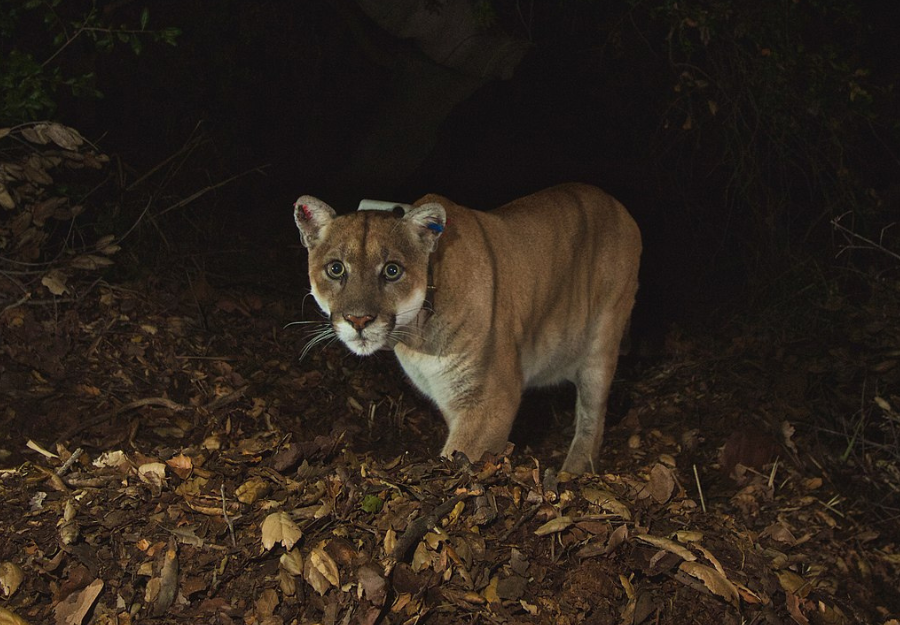
On Anniversary Of P-22’s Death, Let Us Recommit To Saving Mountain Lions Across The United States

An op-ed published in the Los Alamos Daily Post

By R. Brent Lyles, Sharon Negri and Julie Marshall

Sunday marks the first anniversary of the death of P-22, a most beloved mountain lion who lived among Angelenos in Griffith Park for more than a decade.

P-22 lived life large as a celebrity bachelor feline, although he probably didn’t care much about Hollywood glamour. He was photographically captured by National Geographic amid the starry night’s Hollywood sign.

This was a lion who brought stalwart wildlife biologists to tears when they talked about his life and legacy: The legend of P-22 continues to grow, and his spirit lives on in a documentary, public art installations, and an exhibit at the Natural History Museum of L.A. County, just to name a few. In fact, P-22 became famous well beyond his home state, and he’s still talked about with love and appreciation across the country and around the world.

The protections demanded by Angelenos for P-22 provide much-needed inspiration for those of us fighting to protect P-22’s extended family throughout the American West. Mountain lions are being treated with the most egregious disrespect and cruelty seen since the wildlife persecution era, more than a century ago. Angelenos accepted a mountain lion to live among them in a relatively small urban space, but wildlife policymakers in most Western states have become much less welcoming — in fact, many policymakers are brazenly hostile toward mountain lions naturally existing on vast wild landscapes across the West.

This year in Utah, lawmakers succeeded in calling for an all-out war on mountain lions, allowing them to be randomly killed as well as caught in snares, often just for fun, at any time of year. Utah’s entire population could be wiped out in just a few years, conservationists say. Similarly, Idaho opened the floodgates to increased recreational hunting with just two months of reprieve for apex carnivores, who will be increasingly chased down by packs of dogs. Hounding is allowed in nearly every state that allows this kind of ethically dubious hunting. It’s little different from shooting a mountain lion in a cage, since once the hounds chase a lion up a tree, the cat is helpless to escape being shot at close range and falling to his or her death.

Other states are simply choosing to disregard the best science of basic lion ecology, stick their heads in the proverbial sand and pretend that new and valuable research doesn’t exist. South Dakota is considering accepting a lowered population of lions on the landscape in exchange for more hunting opportunities, for little reason other than that it’s a fun activity for a minority of people who primarily want to collect trophies (a head and a hide). It’s fundamentally no different from trophy hunting the African lion.

Washington state recently increased lion hunting after elk populations were reduced by extreme weather and wildfire. Montana and Wyoming are similarly using declining mule deer as excuses to boost lion killing as recreation. Our best collective research has laid to rest the idea that less lions equals more ungulates. Nature is never a simple math equation, but rather a complex and biodiverse system where wildlife is impacted by weather, disease, development, drought, habitat loss and many other multiple factors that demand consideration, rather than scapegoating a single species.

In contrast, there is great hope in Colorado as citizens of that state are looking to follow in California’s footsteps by banning trophy hunting of its mountain lions (as well as trapping bobcats) with a 2024 ballot measure called Cats Aren’t Trophies (catsarenttrophies.org). And in Florida, federal officials proposed a large wildlife refuge to protect mountain lion habitat near the Everglades, and they are acquiring land to provide safe crossings from south Florida to Georgia. We need this hope, because today with the regressive policies and permissive exploitation of mountain lions across the West, we are not only failing morally, but we are causing great harm to whole ecosystems at a precarious time.

Today we know better, and we can do better. We know that mountain lions are sentient and shy, elusive creatures who would rather avoid humans altogether. New and exciting research shows us that lions provide unique ecological services as apex carnivores, benefiting at least 500 other species. Mountain lions are a key to climate resiliency and to stopping the biodiversity losses that are happening everywhere we look. Some research has even indicated that lions selectively target deer infected with chronic wasting disease (CWD), an insidious infection without a cure that is rapidly spreading across the country, ravaging deer populations, and threatening wildlife and potentially humans. CWD was even recently detected inside Yellowstone for the first time.

On Sunday we celebrate the remarkable life of one lion named P-22. His light still shines brightly in the memories of those of us who live in lion country and yearn for a future where mountain lions are protected, as he was. We envision a world where mountain lions are not villainized and killed for fun and under false pretense. It’s ironic that P-22 was so warmly welcomed into a world of neighborhoods and freeways, while others of his kind, trying to exist in their wild places, are being ruthlessly rooted out from their natural homes. In the name of P-22, we must keep fighting to end the cruel and unnecessary killing of lions for trophies, for the welfare of humanity and for the health of the planet.

R. Brent Lyles is Executive Director of the Mountain Lion Foundation, which is based in Sacramento, California. Sharon Negri is director of WildFutures and lives in Northern California. Julie Marshall is National Communications Coordinator for Animal Wellness Action and the Center for a Humane Economy, based in Washington DC, and lives in Colorado.

Reflecting on the Legacy of P-22

A Year After the Passing of the Iconic Puma of LA’s Hills

by Josh Rosenau

P-22, the mountain lion who lived in Los Angeles’ Griffith Park for nearly a decade and captured the hearts of Angelenos, died one year ago on December 17, 2022.

As a young mountain lion, P-22 made headlines by crossing two of LA’s massive freeways to find his long-time home in Griffith Park. The freeways that slash through patches of forest in LA’s hills challenge all wildlife but create a special problem for mountain lions. One mountain lion usually needs dozens or hundreds of square miles to find prey, to hide and rest, additional room for mates, and to rear cubs.

The mountain lion P-22 walking in front of the Hollywood sign.
P-22 before the Hollywood sign. By Steve Winter

National Geographic photographer Steve Winters’ iconic photograph of P-22 in front of the Hollywood sign came to symbolize the strength and courage needed to make that long crossing. It cemented the cat as an A-lister and galvanized a movement to save LA’s cougars.

Like many Angelenos, P-22 made do with a tiny home compared to his kin farther afield. The food scene was excellent, providing all the deer he needed. But like many Angelenos, he found the dating pool limited; without another risky freeway trip, no mates were within reach.

He experienced nearly all the dangers threatening the survival of mountain lions: cars, poisons, humans, shrinking habitat and inbreeding.

Cars, in particular, posed a constant threat to his safety and blocked his access to mates. His plight galvanized public support for a massive wildlife crossing across one of LA’s largest freeways.

The Wallis Annenberg Wildlife Crossing will serve as a legacy that P-22 leaves to all his relations. It is also a testament to the hard work of legislators, state agencies, philanthropists, and mountain lion advocates nationwide. The Wallis Annenberg Wildlife Crossing is already inspiring the construction of more wildlife crossings, particularly in areas where they can help mountain lion populations from becoming genetically isolated. These crossings will help many populations of mountain lions.

Learn more about the Wallis Annenberg Wildlife Canyon Crossing: On Crossings

While California had stringent laws to protect carnivores from rodenticides, P-22 needed veterinary care for mange after eating rodenticide-tainted meat. His suffering from rodenticide helped raise the profile of this threat to wildlife and it spurred people to action.

In 2023, wildlife advocates celebrated the passage of Assembly Bill 1322, which expanded the moratorium on rat poison to also include diphacinone, a first-generation anticoagulant rat poison, developed before 1970. This new law, also known as the California Ecosystems Protections Act of 2023, will take effect Jan. 1, 2024.

Read: New law will ban rat poison that was harmful to wildlife

In addition to his secretive life within busy Griffith Park, P-22 was occasionally sighted lounging on sidewalks or apartment staircases nearby. Such close encounters elsewhere can sometimes lead to uninformed and lethal responses, but luckily, his celebrity and good disposition meant people took those encounters in stride.

His easygoing behavior changed in the last month of his life. He was struck by a car, lost the use of one eye, and suffered other injuries that made it hard to hunt. When he attacked several small dogs, wildlife agencies had little choice but to track him (to a backyard) and take him for veterinary care.

During those last weeks, he was lionized by civic leaders, wildlife advocates, and the citizens of LA. Comedians and screenwriters plotted elaborate heists to spring P-22, while strained public relations with LA’s police and sheriff departments produced calls not to snitch on the cat’s location. After it was determined that euthanasia was the cat’s only option, LA’s elected leaders began plans to memorialize the lion with a statue in Griffith Park.

The loss of mountain lions from wild places hurts us all. As we reflect on P-22’s life, it’s incredible to see just how much he inspired people to take conservation action.

The Mountain Lion Foundation is committed to protecting and preserving the presence of these animals throughout their range and we are grateful to everyone who has been moved by P-22’s story.

Make a year-end gift to support mountain lion conservation.

Looking Forward to 40 More Years of the Mountain Lion Foundation

We are excited to share a very special message from Sharon Negri, the Mountain Lion Foundation’s founding Director. We are grateful for her continued partnership, and we hope you are inspired to action by her message. You’ll also find an informational sheet about where we are concerned for mountain lions, and where we find hope for their future.

Donate Today!


As the holiday season approaches, we are especially thankful for our members. We ask those who share our deep appreciation for mountain lions to come together by making a special year-end donation in support of our continued efforts on behalf of these magnificent creatures — so that they may not only survive, but flourish in the wild. We hope you will honor us with a year-end gift today.

As you know, we design our programs to raise awareness about the importance of mountain lions and their habitats, advocate for policies that protect them, and support coexistence with these remarkable creatures. Through education, outreach and activism, we are working to create a future where mountain lions and their habitats are protected and thriving.

The Mountain Lion Foundation succeeds because people like you cherish our beautiful big cats and recognize the importance of standing up to preserve our natural world and protect the creatures that call it home.