What your support makes possible: staying with the work long enough to give mountain lions a way across I-15.
In February 2026, the California Wildlife Conservation Board awarded $3,988,000 in Proposition 4 funding to advance the design and permitting of a wildlife overpass across Interstate 15, just south of Temecula in southwestern Riverside County, California. The proposed Rainbow Canyon overpass would restore a critical connection between the Santa Ana and Palomar mountains, allowing mountain lions and other wildlife to cross a freeway that has largely cut off movement between these populations. For the Mountain Lion Foundation and our partners, it’s a milestone in a fight that began years ago to keep one of the region’s last wildlife corridors open.
Protecting the Land for a Future Crossing
In 2018, we joined the Center for Biological Diversity, Sierra Club and Cougar Connection in challenging the proposed Altair development in Temecula. Endangered Habitats League filed a parallel lawsuit. In March 2020, a court ruled that the development’s environmental review had failed to adequately address impacts on Santa Ana mountain lions, among other deficiencies. The conservation groups subsequently reached a settlement with the city and developer in October of that year.
The settlement protected the 55 acre South Parcel habitat near the headwaters of the Santa Margarita River as natural open space. Separately, it required the developer to transfer a 65 acre property along the west side of I‑15 to the Western Riverside County Regional Conservation Authority. The Nature Conservancy had already acquired 73 acres directly across the freeway. Together, these two properties secured the land needed on both sides of I-15 for a future wildlife crossing. We’re grateful to Vicki Long and Cougar Connection and to all the partners who helped make that possible.
Reconnecting Mountain Lion Populations
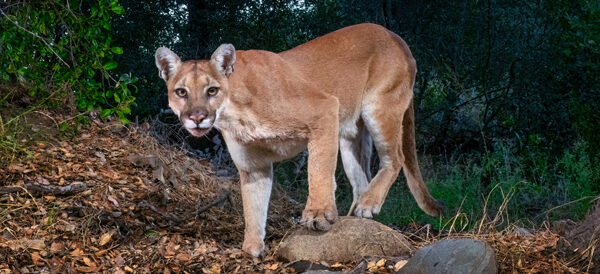
For mountain lions in the Santa Ana Mountains, reconnecting habitat across I-15 could be critical to their long-term survival. The population, listed this year as Threatened by the California Endangered Species Act, has become genetically isolated, with very limited immigration from populations to the east. If mountain lions can successfully cross the freeway and reproduce, they could restore some of the genetic diversity that has been lost over generations. The vegetated overpass could also give mule deer, bobcats and other wildlife a route across the freeway.
The Work Ahead
The grant supports the Temecula-Elsinore-Anza-Murrieta Resource Conservation District (TEAM RCD), working with The Nature Conservancy, Caltrans, and the Regional Conservation Authority, to advance environmental review, permitting, and engineering design. This phase is expected to continue through 2029. Additional engineering work and construction funding will still be needed before the overpass can be built.
Rainbow Canyon is a good example of why conservation work often requires persistence. Our coalition helped secure a legal commitment to protect land that a future wildlife crossing would depend on. Six years later, that land is part of a funded effort to reconnect two mountain lion populations that would have continued to be separated by I-15. There is still work to do, but an important piece of the solution is now in place.