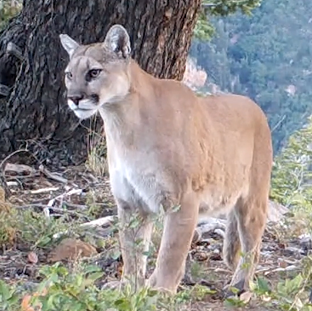
With about 93,000 square kilometers of habitat, Utah’s cougar population is currently somewhere around 1,600 (according to Darren de Bloois from the Utah Division of Wildlife Resources) animals and likely declining due to increased trophy hunting and habitat loss.
Learn more about current mountain lion policy, history, laws, and habitat.
If you are dismayed that Utah is now allowing year-round mountain lion hunting and trapping, support our lawsuit challenging the state’s bad law.
On November 29, 2003, the State of Utah responded to the lawsuit filed by the Mountain Lion Foundation, moving to dismiss the suit. The Mountain Lion Foundation and our co-plaintiffs have until 12/13/2023 to file a response, and a judge will ultimately have to rule on whether and how the lawsuit proceeds.
On October 18, 2023, the Mountain Lion Foundation and partners filed a lawsuit challenging HB 469, challenging the law’s removal of hunting and trapping restrictions as a violation of the state’s “Right to Hunt” constitutional amendment.
At the June 8, 2023 meeting of the state’s wildlife commission, Division of Wildlife Resources staff explained their current understanding of the changes that will follow from new legislation allowing year-round hunting and trapping of mountain lions. They emphasized that they did not interpret the law as ending bag limits or other specific rules regulating the mountain lion hunt and held out the likelihood of new rulemaking in coming months to tighten those rules and establish new policies governing mountain lion trapping — a practice outlawed in every state but Texas.
HB0469 went into effect on May 3, 2023. This legislation allows year-round cougar hunting and introduces trapping into the state of Utah. The cougar addendum was added in the bill’s final hours and not brought to the attention of the representatives voting to approve leaving the Utah Division of Wildlife Resources (DWR) blindsided as much of cougar management was removed from them. As a result, the rules for cougars are as stated in the bill. Cougars are still a protected big game species. Hunters will be required to turn lions into the Utah DWR as usual, obtain their general hunting license, and night hunting is still prohibited. The Department will seek public comment on how to approach lion regulations and the new legislation this year, so keep an eye on news releases from both Utah DWR and the Mountain Lion Foundation for how you can help lions in Utah.
Like most western states, cougars in Utah were first managed through a bounty process, then left unclassified for a few years, followed by the species listing by Utah Division of Wildlife Resources (UDWR) as a game animal and trophy hunted for recreation.
All of these management practices contain a single common element: killing cougars to benefit a small group of men. Though management plans claim to be focused on preserving healthy populations, trophy hunting opportunities have always been the priority.
During the bounty period, most people were concerned only about how quickly the species could be eradicated. The few who were directly involved were motivated by how much money they could make by turning in a kill. The underlying intentions of today’s decision-makers are much less clear.
In 1996 the Utah Wildlife Board approved a Predator Management Policy that authorizes the UDWR to increase cougar harvest quotas on management units where big game populations are depressed, or where big game has recently been released to establish or supplement new populations. According to the UDWR’s most recent Cougar Management plan, “most predator management plans that affect cougars have been designed to benefit mule deer and/or bighorn sheep.” A study released in March 2019, however, suggests that targeting mountain lions to boost mule deer populations may have the opposite effect.
Utah’s 2015-2025 Cougar Management Plan states that the primary objective in Utah is to “maintain a healthy cougar population within their current distribution while considering human safety, economic concerns, other wildlife species, and maintaining hunting traditions through 2025.” The Cougar Management Plan was designed to help guide the UWDR’s management decisions in the state. Yet, despite the best available science, quotas in Utah continue to rise. In 2018, for example, the Wildlife Board approved a quota of 642 mountain lions which was up from 579 from the year before.
In 2019, UDWR estimated the mountain lion population in the state to be around 2,700 adults, but according to Darren de Bloois at the UDWR as of 2022, there are about 1600 adult cougars. In the wake of the approval of HB0469, this number may fall in upcoming years.
In 1888 the Utah Territorial Legislature classified the cougar as an “obnoxious animal” and established a bounty. The program paid a reward for each cougar killed during the next 71 years. Utah ended its cougar bounty program in 1959. Partial records exist for 1913-1959, revealing at least 3,784 cougars will killed and turned in for a bounty payment during this time period.
After Utah discontinued their cougar bounty program, there followed eight years (1959-67) where cougars were unprotected and more than 714 were killed. Records are spotty as best and likely many, many more lions were killed during this time period as well.
In 1967, Utah reclassified the cougar as a “game animal.” Since then annual trophy hunting quotas and mortality have continued to rise.
The State of Utah encompasses approximately 220,000 square kilometers of land (85,000 square miles). The Utah Division of Wildlife Resources (UDWR) states that cougars can be found in forested regions of the state, which represent around 92,696 square kilometers (35,790 square miles) of land, or approximately forty percent of the state.
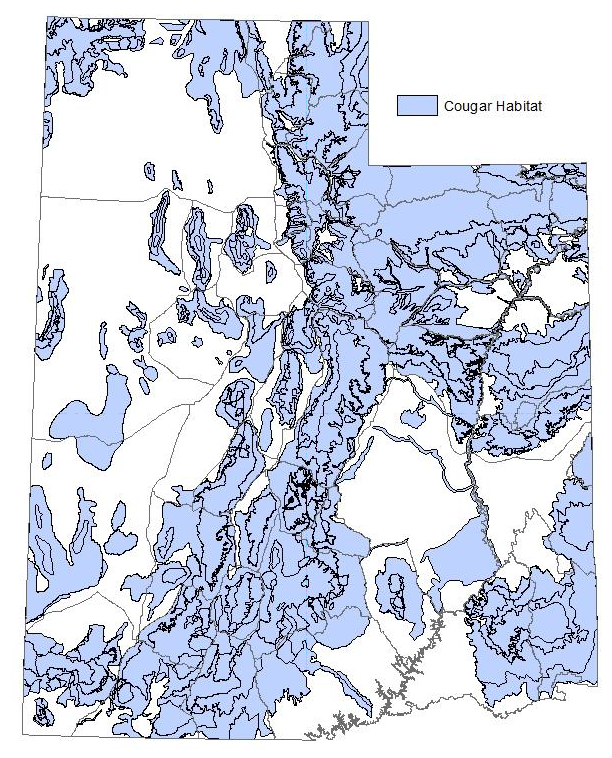 According to UDWR, “cougars occupy 92,696 km2 (35,790 mi2) of habitat. Cougars are distributed throughout all available eco-regions and exhibit a broad habitat tolerance occurring from the semi-arid low-elevation pinion-juniper belt, to the mesic, aspen and conifer dominated forests of the higher mountains and plateaus. Habitat quality varies by ecoregion with the Colorado Plateau and Great Basin containing smaller, naturally fragmented habitats with lower cougar densities, and the mountain ecoregions comprised of relatively large, mesic patches (Stoner et al. 2013a).
Residential and commercial development is incrementally reducing cougar distribution through habitat alteration and destruction, particularly along the western border of the Wasatch Mountains in northern and central Utah. The last statewide cougar population estimates were developed in conjunction with the Utah Cougar Management Plan in 1999.”
These early UDWR calculations estimated anywhere from 2,500 to 4,000 cougars in the state. More recent research in the United States and peer-reviewed publications by leading cougar biologists indicate cougar density is roughly 1.7 resident adults per 100 square kilometers of habitat.
With about 93,000 square kilometers of habitat, Utah’s cougar population is currently somewhere around 1,600 animals and likely declining due to increased trophy hunting and habitat loss.
The species is classified as a game animal, along with any “wildlife normally pursued, caught, or taken by sporting means for human use.”
The species also is covered by Utah’s definition of “protected wildlife,” along with crustaceans, mollusks, and other vertebrate animals living in nature, except feral animals.
Generally, treatment of wildlife in the State of Utah is governed by the Utah Code — the state’s collection of laws. Utah’s department rules and regulations can be found in the Utah Administrative Code. Since our summary below may not be completely up to date, you should be sure to review the most current law for the Utah.
You can check the statutes directly at a state-managed website: https://le.utah.gov/ These statutes are searchable. Be sure to use the name “cougar” to accomplish your searches.
Utah’s Wildlife Resources regulations are found in the Natural Resources section of the Utah Administrative Code. The Utah Wildlife Board sets these regulations.
The Utah Wildlife Board is a seven-member board whose members are appointed by the governor and confirmed by the Utah Senate. The Director of the Division of Wildlife Resources serves as the board’s executive secretary but may not vote on policies. The board is assisted by Regional Advisory Councils. Board members serve 6-year terms. Terms are staggered so that approximately one-third of the board members are appointed every 2 years. The governor selects board members from a list submitted by the Wildlife Board Nominating Committee, an 11-member body whose members are appointed by the governor. No more than two board members may reside in the same wildlife region; members from the same region are appointed at different times so their terms do not expire in the same year. Board members must have expertise in at least one of the following areas: wildlife management or biology; habitat management, including range or aquatic; business, including knowledge of private land issues; or economics, including knowledge of recreational wildlife uses. There are no political diversity rules regarding the board’s composition.
The Utah Division of Wildlife Resources (UDWR) is part of the Utah Department of Natural Resources. The division enforces the Utah Wildlife Board’s regulations. The division is tasked with acting as the trustee and custodian of protected wildlife.
The Utah Cougar Management Plan V.3 is slated to serve the state until 2025. The plan was adopted in 2015. It was written by the Utah Cougar Advisory Group with the goal of “maintain[ing] a healthy cougar population within existing occupied habitat while considering human safety, economic concerns, and other wildlife species through 2025.” Management plans are prepared on the orders of the Utah Division of Wildlife Resources and is then used to direct the UDWR’s management of mountain lions.
Hunting of mountain lions is allowed in the State of Utah. The regulations governing “recreational” hunting of mountain lions specify 96 cougar hunting units. Mountain lion hunting season generally runs from November 7 to May 31 unless the total quota or female quota is met in areas with harvest objectives before the season ends. Hound hunting is allowed.
Utah allows the hunting of mountain lions with any firearm not capable of being fired fully automatic and bows. Utah also allows disabled hunters to use crossbows.
Utah’s list of regions where mountain lions may be hunted and maps of those regions can be found here.
Quotas are set by the Utah Wildlife Board after receiving input from UDWR biologists. The board also receives input from the public and interest groups through the Regional Advisory Councils.
Utah allows people to kill or seriously injure a mountain lion when “when the person reasonably believes such action is necessary to protect them self, another person, or a domestic animal against an imminent attack by the wild animal that will likely result in severe bodily injury or death to the victim.” The person must then notify the UDWR within 12 hours. The mountain lion’s body or any parts of it may not be removed from the site, repositioned, retained, sold, or transferred without written authorization from the division.
Depredation in Utah is monitored by the Utah Division of Wildlife Resources. The regulation specifies that the livestock’s owner, a member of the owner’s family, or regular employee of the owner may kill a mountain lion that is attacking or has been attacking livestock. The owner may also notify either the UDWR or the US Department of Agriculture (USDA) of the depredation and a local hunter or a USDA Wildlife Services specialist will be appointed to kill the depredating lion. The carcass must be delivered to the UDWR within three days. The UDWR may allow the individual to keep the mountain lion’s body if he/she wishes, but an individual may only keep one mountain lion per year.
Owners of domestic animals are required to take certain steps to protect their pets or livestock, including paying an annual fee to cover the costs of the Utah Department of Agriculture and Food’s predator control services. Those who fail to pay the fees may receive only minimal levels of service. There is a government-funded compensation program for losses of domestic animals to mountain lions.
Beginning in May 2023, HB0469 made it legal to trap mountain lions for fur in Utah.
Poaching laws in the State of Utah provides some protection of mountain lions in law, but only as a deterrent. It is rare for penalties to be sufficiently harsh to keep poachers from poaching again. Utah lists the killing of a mountain lion while trespassing as a class B misdemeanor, which can be punished with up to 6 months of imprisonment. The state considers “wanton destruction” of a mountain lion to be a class A misdemeanor, for which the offender may be imprisoned for up to one year. Utah law recommends that those who illegally kill or possess a mountain lion be fined at least $350 per animal.