Welcome to the latest edition of America’s Lions Share, your monthly update on the stories, science, and people shaping the future of mountain lion conservation.
Today is Giving Tuesday, a day when people across the country join together to support the causes that matter most. For us at the Mountain Lion Foundation, this day holds special meaning.
As we approach MLF’s 40th anniversary, we are stepping into a new chapter of conservation shaped by science, community partnership, and a renewed commitment to protecting America’s lion. Mountain lions face shrinking habitat, dangerous roads, and outdated policies — but together, we can protect the wild places they depend on.
Your Giving Tuesday gift fuels:
• Science-driven advocacy that protects habitat and wildlife corridors
• Coexistence programs that keep people and lions safe
• Storytelling and education that reconnect people to nature
• Policy reform that reflects modern science and shared values
Every contribution today helps keep America’s wild — wild.
Connectivity Shapes the Future of Mountain Lion Resiliency and Recovery
by Byron Weckworth, Chief Conservation & Advocacy Officer
WHAT WILDLIFE CONNECTIVITY REALLY MEANS FOR MOUNTAIN LIONS
Most conversations about mountain lion conservation dwell on numbers, how many cats are there in an area, how many are killed each year, what’s the population goal for recovery? As important as those are, numbers alone don’t tell the full story. To survive and thrive, puma depend on something harder to measure and even harder to maintain: the ability to move through a landscape without running into dead ends. That simple function, crossing ridgelines, navigating valley bottoms, slipping through the mosaic of human development, determines whether populations stay genetically healthy, whether isolated groups avoid extirpation, and whether historic range gets recolonized. Connectivity, more than any numerical figure, is the real barometer of the species’ future.
Connectivity, in the ecological sense described by Brodie et al., is less about individual animals moving around and more about how entire landscapes function as an integrated system. When habitats are linked, the natural mechanics of dispersal, gene flow, and population rescue operate as they were meant to in a fully functioning network. When linkages weaken or disappear altogether, populations are more vulnerable to the stressors of climate extremes, local disturbance, and the merciless pressures of infrastructure development. Connectivity is now recognized as a fundamental property of resilient ecosystems, influencing how wildlife responds to change and how species maintain the evolutionary potential needed to adapt. For a wide-ranging, low-density species like the puma, the integrity of these connections is often the difference between stable populations and the drift towards decline.
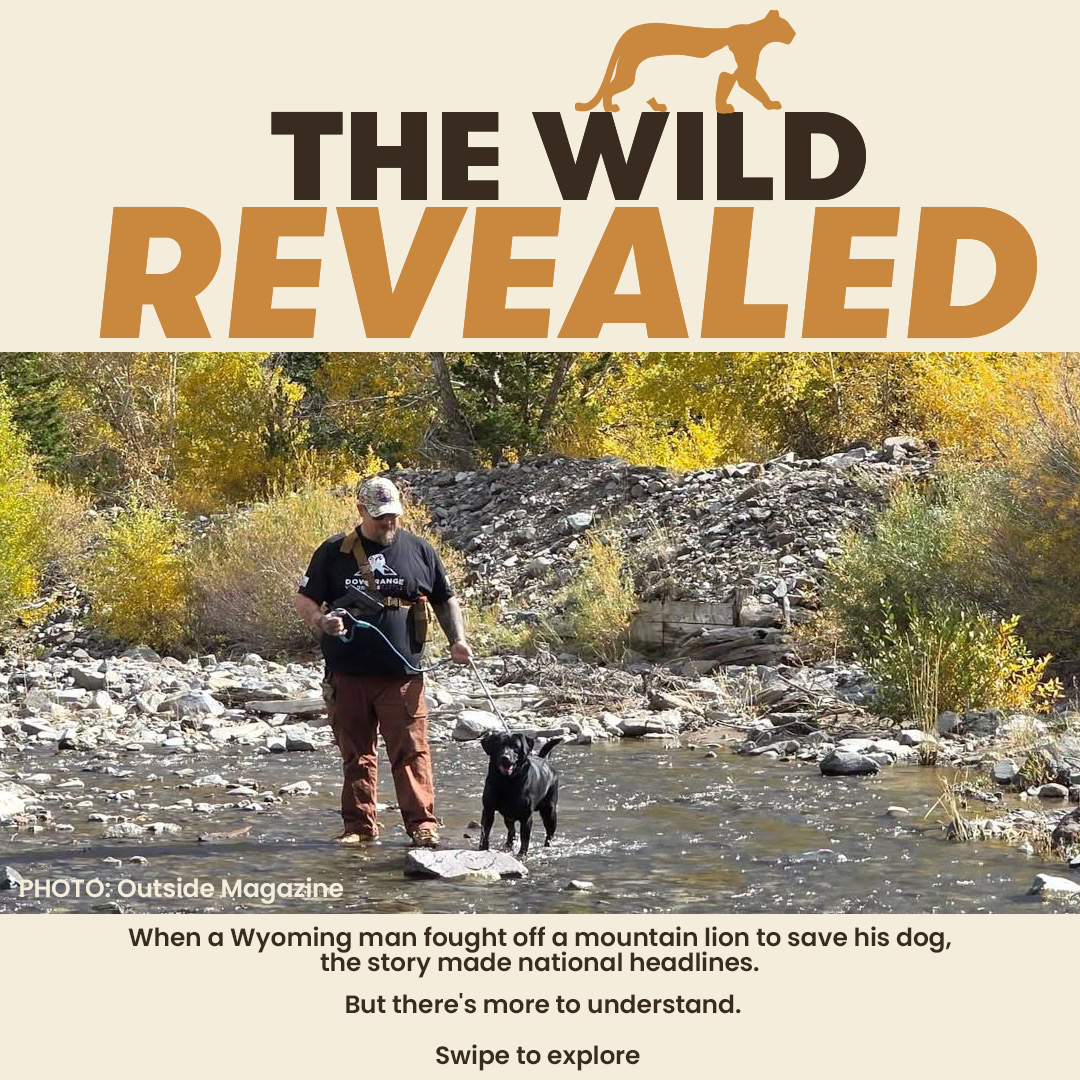
COEXISTENCE IN ACTION
HONORING OUR LEGACY
Bob McCoy: A Story of Persistence and Protection
HOW ONE VOLUNTEER BECAME A LEADING MOUNTAIN LION ADVOCATE
Bob’s relationship with the Mountain Lion Foundation began in 2009, when his personal research into Puma concolor led him to the organization. Very quickly, his commitment turned into action: he played a pivotal role in successfully stopping the Washington Cougar Hounding Pilot Program, a turning point that catalyzed his founding of the Washington Cougar Coalition (WA Cougar) and his appointment as MLF’s Washington State Field Representative. Over the past 15+ years, Bob has become one of MLF’s most dedicated advocates, strategists, and institutional leaders.
MY MOUNTAIN LION STORY: A FIRST ENCOUNTER WITH A MOUNTAIN LION , A CHILDHOOD MEMORY
by David Thornton
A QUIET WALK INTO THE BIG BEAR WILDERNESS
When I was maybe 12 years old, I was walking a trail with my dad and older brother. My dad was deer hunting in the Big Bear Lake area of California (this was the early 1950s). He was a hunter who never shot anything but loved being in the wilderness. He was also prone to bringing home injured animals if he found them—much to my mom’s dismay.
We were walking along a trail that led down to a gully with a small stream at the bottom.
TELL US YOUR WILD STORY
Do you have a mountain lion sighting, experience, or personal connection you’d like to share? We’re collecting stories from supporters to highlight in future newsletters and outreach. Click the link below to add your voice.
Honoring Don Molde’s Legacy
Many in the Mountain Lion Foundation community knew and admired Don Molde, a longtime MLF board member, fierce advocate for wildlife, and one of Nevada’s most respected voices for ethical, science-based wildlife policy. Don passed away earlier this year, leaving behind a legacy defined by courage, persistence, and an unwavering commitment to protecting wild animals—especially mountain lions.

WILLOW: Diary of a Mountain Lion Nature on PBS Documentary
Never-before-seen behaviors are shown in a decade-long mountain lion study throughout Montana’s mountains through the eyes of a female named Willow.
Can mountain lions comeback in the US northeast? One group hopes so
Reintroducing the apex predator would control deer populations, maintaining healthy ecosystems and bolstering biodiversity, rewilding group says
This Giving Tuesday: Keep America’s Wild – Wild
Stand with America’s lion and help launch the next chapter of mountain lion conservation.
Your gift today protects mountain lions and the wild places we all depend on.
GET THE NEXT ISSUE IN YOUR INBOX
Don’t miss the latest stories, news, and opportunities to take action for mountain lions. Sign up to receive America’s Lions Share directly in your email.